
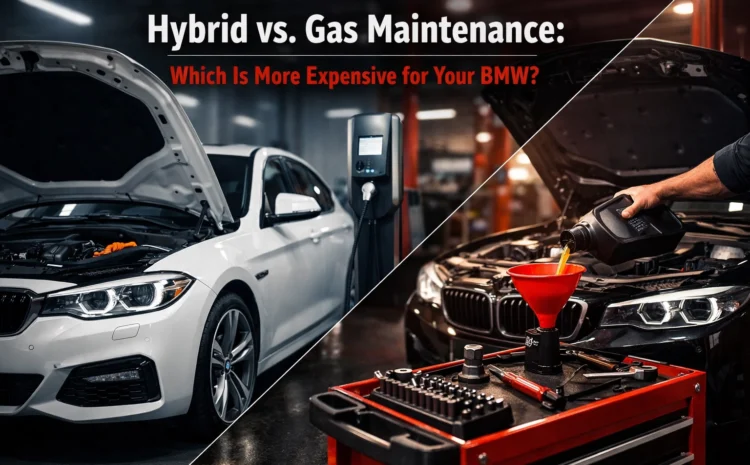
Hybrid vs. Gas Maintenance: Which Is More Expensive for Your BMW?
For the BMW enthusiast, the driving experience is everything. Whether you are carving through the winding backroads of Anne Arundel County or gliding down US-50 toward the Bay Bridge, your vehicle is more than a mode of transport: it is a finely crafted machine. But as BMW expands its lineup of Plug-in Hybrid Electric Vehicles (PHEVs) like the 330e, 530e, and the powerhouse X5 xDrive45e, many Arnold drivers are asking a critical question: Does the high-tech efficiency of a hybrid come with a higher price tag at the repair shop?
Choosing between the traditional roar of a TwinPower Turbo inline-six and the silent surge of an electric motor involves more than just fuel economy. It’s about the long-term investment in your vehicle’s longevity. At German Automotive Performance, we see both sides of the coin. Here is the definitive breakdown of maintenance costs for hybrid versus gas BMWs.
The Traditional Internal Combustion Engine (ICE): The Benchmark of Performance
The gas-powered BMW engine is a masterpiece of engineering. However, maintaining that “Ultimate Driving Machine” feel requires meticulous attention to a complex network of moving parts.
1. The Routine of the Road
In a traditional gas BMW, the engine is the sole workhorse. This means components like spark plugs, ignition coils, and drive belts bear the full brunt of every mile driven in Maryland’s humid summers and freezing winters.
- Symptoms: Rough idling, decreased fuel economy, or a hesitant throttle response.
- Solution: Adhering to a strict schedule of general repairs and services ensures that carbon buildup doesn’t rob your engine of its soul.
2. Cooling Systems: The BMW Achilles’ Heel
Precision-engineered engines run hot. BMWs are notorious for cooling system components: plastic expansion tanks, water pumps, and thermostats: that require replacement every 60,000 to 80,000 miles to prevent catastrophic overheating.
The Hybrid Advantage: Why “Double the Parts” Doesn’t Mean Double the Cost
A common misconception is that because a hybrid has both an electric motor and a gas engine, it must be twice as expensive to maintain. In reality, the hybrid system often acts as a guardian for the mechanical components.
1. The Magic of Regenerative Braking
This is perhaps the biggest “win” for hybrid owners. When you lift off the accelerator in a 330e, the electric motor reverses to slow the car down, capturing energy to charge the battery.
- The Benefit: Your traditional brake pads and rotors are used significantly less. While a gas-powered BMW might need a brake service every 30,000 miles depending on your driving style, a hybrid can often go 60,000 miles or more on a single set of pads.
- Precision Care: Even with less wear, regular suspension and brake inspections are vital to ensure the complex transition between friction and regenerative braking remains seamless.
2. Less Strain on the ICE
In a hybrid, the electric motor handles the heavy lifting during low-speed maneuvers and initial acceleration: the most taxing moments for a gas engine. This reduced workload can lead to a longer lifespan for the internal combustion components.
Head-to-Head: The Maintenance Cost Breakdown
When we look at the data for BMW maintenance in the Arnold, MD area, here is how the costs typically stack up over a five-year ownership period.
1. Oil Changes and Fluid Services
You might assume hybrids need fewer oil changes. While the engine runs less, it still requires synthetic oil that meets BMW Longlife (LL-01 or LL-17 FE+) standards.
- Gas: Standard intervals (typically every 7,500 to 10,000 miles, though we recommend 5,000 for performance longevity).
- Hybrid: Similar intervals, but the oil often faces “moisture contamination” because the engine may not run long enough to reach full operating temperature on short commutes to the Annapolis Mall. Proactive oil service is the “gospel” of hybrid care.
2. The Transmission and Drivetrain
Both platforms utilize the impeccable ZF 8-speed transmission, but the hybrid version integrates the electric motor directly into the housing.
- Maintenance: Both require fluid flushes to maintain crisp shifts. However, the hybrid’s engine and transmission diagnostics are more complex, requiring specialized tools to interact with the high-voltage system.
3. Electrical Systems and Batteries
This is where the costs diverge.
- Gas: You’ll replace a standard AGM battery and perhaps an alternator every 5-7 years.
- Hybrid: You have two batteries. The high-voltage lithium-ion pack is designed to last 100,000+ miles, but if it fails out of warranty, the cost is significant. However, day-to-day, the hybrid lacks a traditional starter motor and alternator, removing two common failure points found in gas cars.
The Arnold, MD Factor: How Local Driving Impacts Your Wallet
Driving in Maryland presents unique challenges. Our stop-and-go traffic on Route 2 (Ritchie Highway) is the perfect environment for a BMW hybrid. By staying in “Max eDrive” mode, you save the wear and tear on your engine’s turbochargers and valvetrain.
Conversely, if you primarily use your BMW for long hauls on I-97, a traditional gas model might be more cost-effective. The added weight of the hybrid battery becomes “dead weight” once the charge is depleted, slightly increasing wear on tires and suspension components.
Diagnostic Precision: The Key to Saving Money
Regardless of which drivetrain you choose, the most expensive repair is the one that could have been prevented. Modern BMWs are computers on wheels. Using advanced auto diagnostics is non-negotiable.
For hybrid owners, specialized software is required to check the “state of health” (SOH) of the battery cells. For gas owners, we look for early signs of oil filter housing leaks or VANOS solenoid issues. Staying ahead of these warning signs is the difference between a $200 sensor and a $4,000 engine overhaul.
Final Verdict: Which Is More Expensive?
- Short Term (Years 1-5): The Hybrid is often cheaper. Lower brake wear and reduced engine strain offset the slightly higher cost of specialized inspections.
- Long Term (Years 8-12): The Gas model is often more predictable. Once a hybrid passes the 100,000-mile mark, the potential (though not guaranteed) cost of battery degradation can swing the pendulum back toward the internal combustion engine.
Maintenance is not a chore; it is an investment in a luxury asset. Whether your BMW glides silently or roars with passion, it deserves impeccable care from technicians who understand the soul of German engineering.
Experience Exceptional Care at German Automotive Performance
Don’t wait for a dashboard light to tell you your machine needs attention. Whether you need a precision performance tune-up for your M3 or a meticulous battery health check for your X5 PHEV, we are your partners in automotive excellence.
Unlock the full potential of your BMW today.

German Automotive Performance
Address: 1300 Ritchie Hwy, Arnold, MD 21012, United States
Phone: (410) 518-9114
Website: germanautomotiveperformance.net
Hours of Operation:
- Monday – Friday: 8:00 AM – 5:00 PM
- Saturday – Sunday: Closed
Serving Arnold, Annapolis, and the surrounding Maryland areas with specialized German automotive expertise.